

INENGLISH
My work has become increasingly discrete, precarious, and rooted in my Caribbean experience. Like the debris in a shipwreck, everything looks dispersed in the sand and underwater, almost about to disappear, I am looking for signs in that wreckage.
I make serial choreographed performances that include sound, dance, text, and installation where the audience dives into a place open to how they want to configure their experience. My artistic process starts by letting myself be affected by my surroundings, physical, digital, or imaginary. My methodology draws from the ingenious, precarious, domestic, and collaborative work tactics I grew on: i.e. resolver. I use those embodied experiences and Caribbean imaginaries as a vantage point to observe and slowly remake contemporary ruins.
ENESPAÑOL
Mi trabajo se ha vuelto cada vez más fragmentado, precario y arraigado en mi experiencia caribeña. Como los restos de un naufragio, todo parece disperso en la arena y bajo el agua, casi a punto de desaparecer, ando buscando señales en esos restos.
Mis obras son series lentas de performances coreografiados que incluyen sonido, danza, texto e instalación donde el público se sumerge en un lugar abierto a cómo quiera configurar su experiencia. Mi proceso artístico comienza dejándome afectar por mi entorno, físico, digital o imaginario. Mi metodología se basa en las tácticas de trabajo inventivas, domésticas, precarias y colaborativas con las que crecí: esto es, resolver. Utilizo esas experiencias físicas e imaginarios caribeños como punto de vista para observar y lentamente reconstruir las ruinas actuales.
the ruins / sobras públicas
Derrotero (2022)


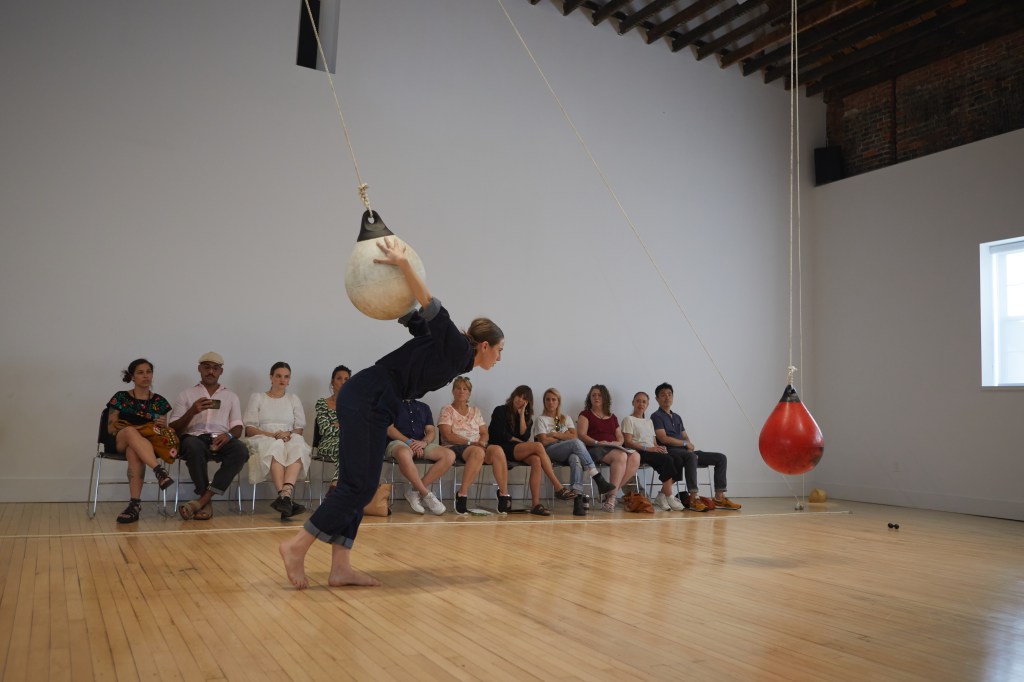
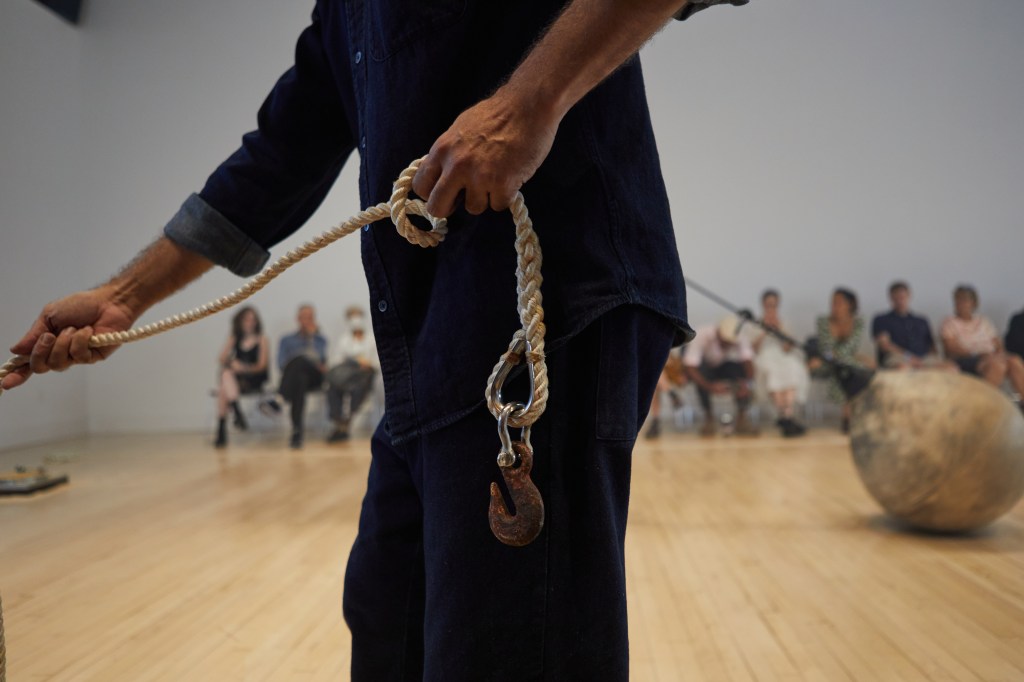
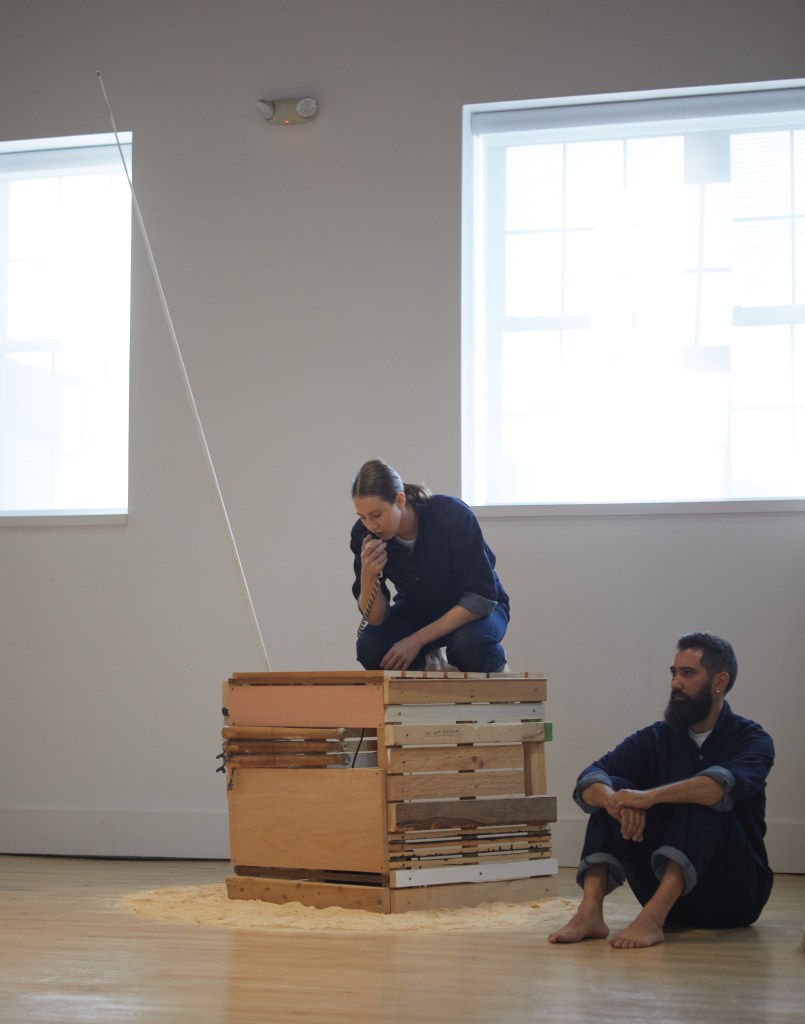

Created and performed by Gabriela Burdsall & William Ruiz Morales
Duration: 30 min
“Derrotero” is a choreographed performance project created and performed by Gabriela Burdsall and William Ruiz Morales with the collaboration of composer Nina Fukuoka and architect Daniela Friedman.
An ephemeral monumental machine
“Derrotero” is a machine dedicated to activating and celebrating personal myths and memories connected to forms of resilience, work, failure, and inventiveness that are common resources of Caribbean subjects. “Derrotero” is a “poetic monument” :
(…) “some monuments of totalitarian regimes and democratic regimes alike fail in allowing the world to be open to us. In Heidegger’s terms, they fail to be poetic. In other words, monuments that resist interpretation and instead present an ideological perspective close off our ability to be mindful and to be reminded in a way that is conducive to active and open public discussion of their role and purpose in our social and political life. Monuments, precisely because they have such great potential to organize public space, because they invoke our past and inspire us to address our future, can be extremely important in public discourse.”
Janet Donohoe, “Dwelling with monuments”
“Derrotero” is poetical in that it assembles various materials to produce new associations and emotions. It pays tribute to found objects and the act of scavenging for them. Poetry emerges in the tension and movements of those objects in dialogue with the human presence, a relation of feedback and respect.
About the process
“Derrotero” is a performance based on immanent fragments. Discrete impressions that we find along the way. We reacted to our environment, collecting elements that became the performance piece. Inventiveness, improvisation, and instability are some of the characteristics of our work. We find those characteristics to be familiar to Caribbean subjects. Our history of failure has made us ready to rebuild in any circumstance as a matter of survival. Our immigrant condition intensifies that readiness, which constantly challenges us to negotiate between our native culture and the one we are inserting ourselves. Our work develops convivial places to exchange sensations and ideas about those crossings.
Restless (2022)
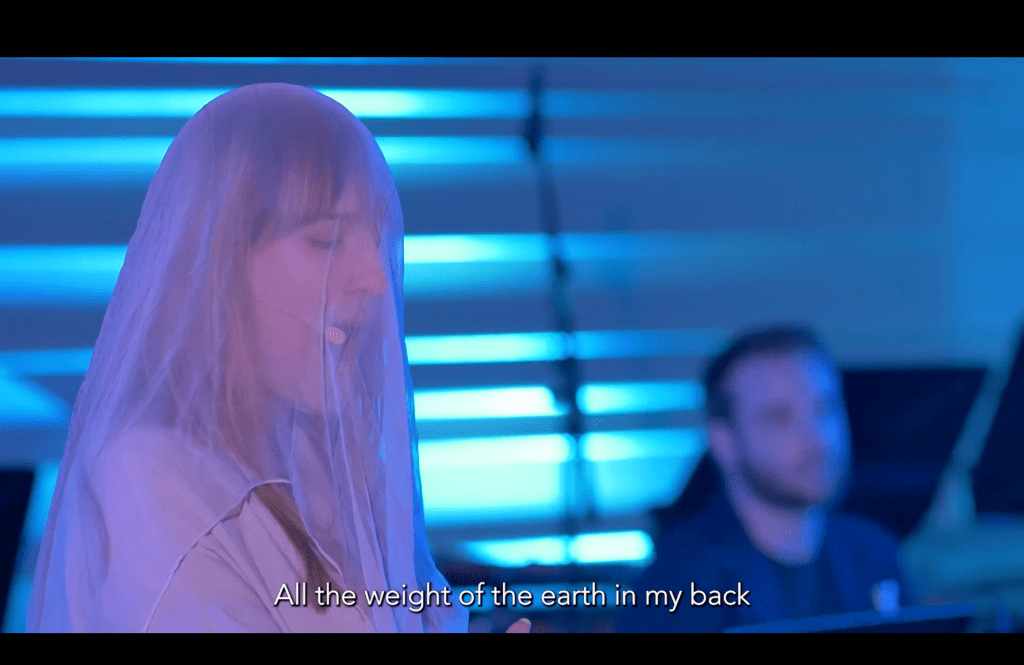
Composition by Nina Fukuoka | Concept William Ruiz Morales and Nina Fukuoka | Text William Ruiz Morales
Duration: 13 min
Written for the International Contemporary Ensemble
Performed on April 16, 2022 as part of the Columbia Composers Presents International Contemporary Ensemble / Columbia Composers Season 2021-22
Zombies confront us with the disease. They are the incarnation of irrational violence, the surplus of our irrational violence. Somehow, they are the afterlife of that violence. They are denied and deny us the possibility to rest. They must keep going, just keep going. No objectives, no hopes, no rationality, just a craving for something that is always disappearing: the end of violence, to be able to stop. We can never understand zombies, they speak a language incomprehensible to us, the language of death and violence. We can only imagine the stories of those zombies: what they do – never what they think. The text for this piece is not what it says it is. It may seem like it’s a small fragment of the zombie language, but it’s not. Instead, the text is a simplified translation, an observation of the rise and steps of a zombie, a familiar image of the incomprehensible nature of the living dead. When the zombies come, it will be too late to learn how to listen.
Breaths (2022)


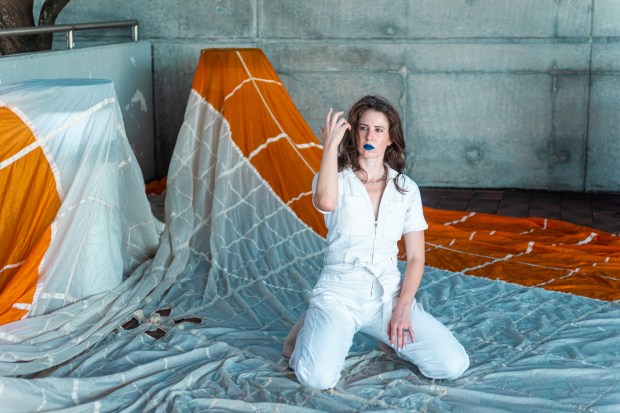

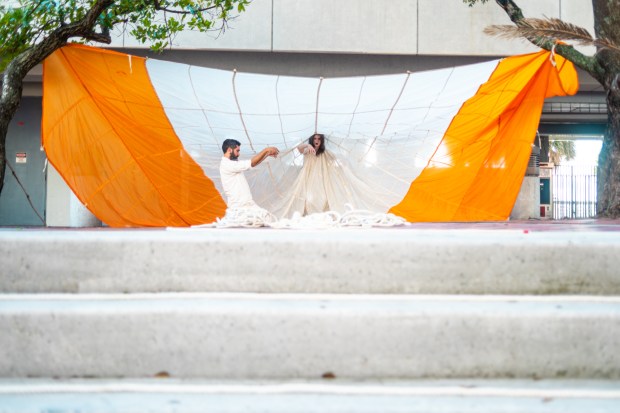
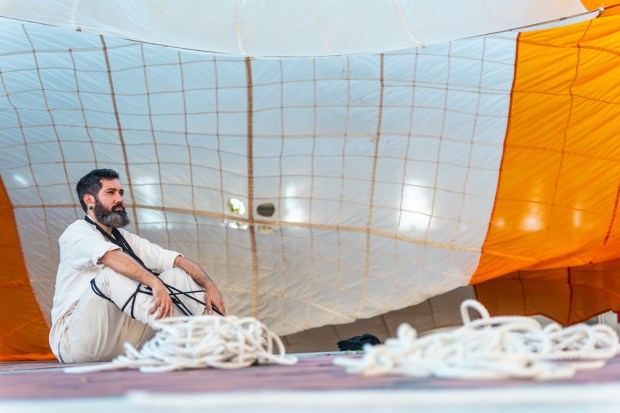
Created and performed by Gabriela Burdsall & William Ruiz Morales
Duration: 2 hours
watch video (series trailer)
Presented as part of the Wake Up Miami series by PAXy, November 2022.
The performance involved a reclaimed parachute originally used by Lorna Burdsall, Gabriela’s grandmother, in her public performances during the 80s in Havana, Cuba. Lorna was a pioneer in extended dance practices that connected her work with some of the most experimental performance art at the time. We wanted to reactivate the parachute in the public space to connect different times and places and try how the new context related to the object. We reactivated its visual possibilities as a sculptural set piece. The parachute defined the space where the dance improvisation sections happened.
The parachute looks like a breathing body when the wind moves it. Lorna also used that possibility in the material in some of her performances. The breathing fabric creates a sensation of flux and wonder in the spectator when it is activated.
The dropped parachute connects us to the accident. When I look at it, it feels like a clue, pointing at something that happened. Something must have happened for it to be here now. The parachute is always foreign; something foreign has arrived. And that foreigner is probably a few miles further, getting deep into strange territory. But this time, it won’t be a soldier, but a wanderer, forced to flee. Lorna never used the parachute in connection to its military nature. It was always something else. I am deeply interested in a process that transformed the object’s meaning from a military artifact to a collective play device, from war to theater, and never a theater of war. Lorna wanted her public intervention with the parachute to be an alternative space for the everyday struggle. In our re-composition, we maintain that objective: our work brings an opening in the daily reality for Miami morning commuters.
Bojeo (2021)
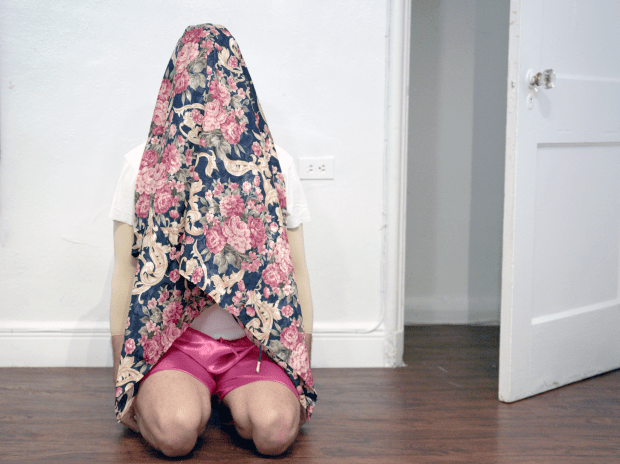


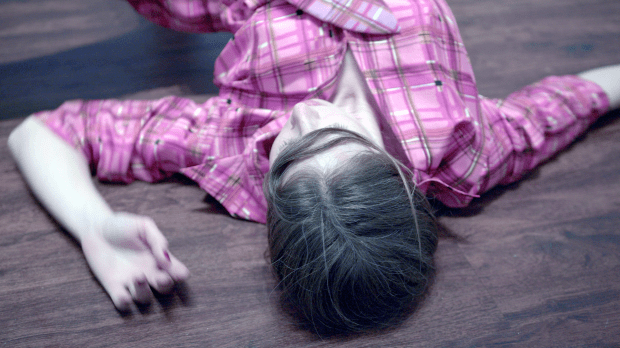
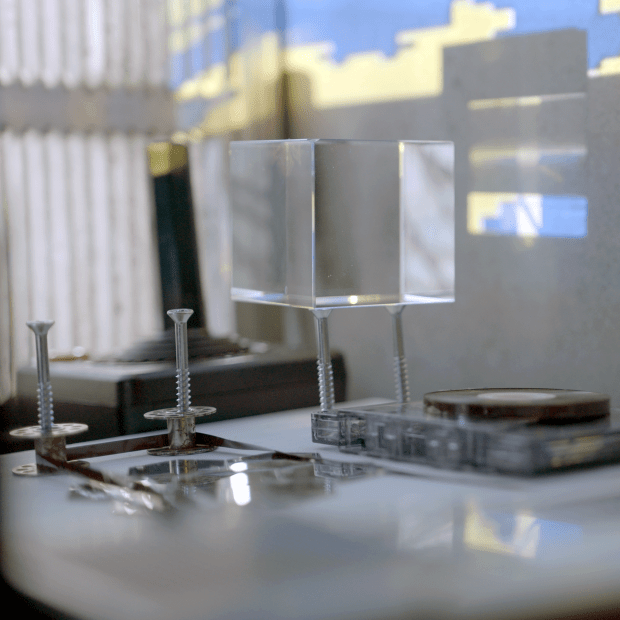


Created and performed by Gabriela Burdsall & William Ruiz Morales
Duration: 40 min
Presented at TOGETHER’s inaugural edition, November 29 – December 5
This iteration of “Bojeo” took a hotel room as its source of materials. From there, we weaved an open theatrical fiction. We explored the hotel room as a space for the transitory, hidden, sensual, and uncanny. In hotel rooms, the private and public space are in constant transformation.
Our “Bojeos” is a series of explorations around our ever-transforming migrant circumstances. Bojeo (roughly “circumnavigation”) is to establish the perimeter of an island. We are interested in the narrative strategies the action of bojear suggests, constantly moving around, listening, and observing rather than occupying. Historically, “bojeos” have been done to arrive at geographical certainties that can be fixed into a map, frequently to help colonization efforts. Our “Bojeo” has an opposite objective: its purpose is to become an opening of the place, a blurring of boundaries, an accumulation of impressions, a proliferation, and a decolonization of the performance place.
Lectures by The Idiot (Series: 2017 – 2021)

Created and performed by William Ruiz Morales with collaborators
Duration: 30 – 45 min
watch video
Lectures by The Idiot is a performance series that uses the lecture format to approach ideas through physical and poetic experiments. With the lectures, we question the concept of knowledge as the transmission of truths, as imposed on us by Western traditions. Instead, we favor an open-ended assemblage of ideas that activate sensorial, humorous, playful, exuberant, localized, transitory, chaotic, truthful, and idiotic thinking.
Previous installments of the Lectures by The Idiot are On Movement (Havana, 2017) and On Truth (New York, 2020).
The Lectures are inspired by radical ideas about the scientific method expressed in concepts such as Donna Haraway’s speculative fabulation. The character of The Idiot, defined by the way it approaches reality, is deeply entangled with the work of Gilles Deleuze, who establishes the idiot as a private thinker as opposed to a public professor. It also draws from the character in Dostoevsky’s novel, where idiocy is similarly explored as a situation where a system of thinking opposes the establishment of ideas.
 Home
Home 